
OT Assignment Instructions
(We recommend you start the Reading Assignment as early as possible!)
For this assignment, you will be required to outline the book of Genesis and write a brief paper reflecting on the significance of Genesis to your life and ministry. This assignment gives you an opportunity to dig deeper into one Old Testament book and consider how to apply what you are learning.
Part 1: Outline
The outline portion of this assignment must go down three “levels.” In other words, you will need to identify the main sections of Genesis with I, II, III, etc.; the immediate subsections with A, B, C, etc.; and the basic progression of each subsection with 1, 2, 3, etc. Also, next to each point/subpoint on your outline, please be sure to identify which section of Scripture the point/subpoint is referring to. For example:
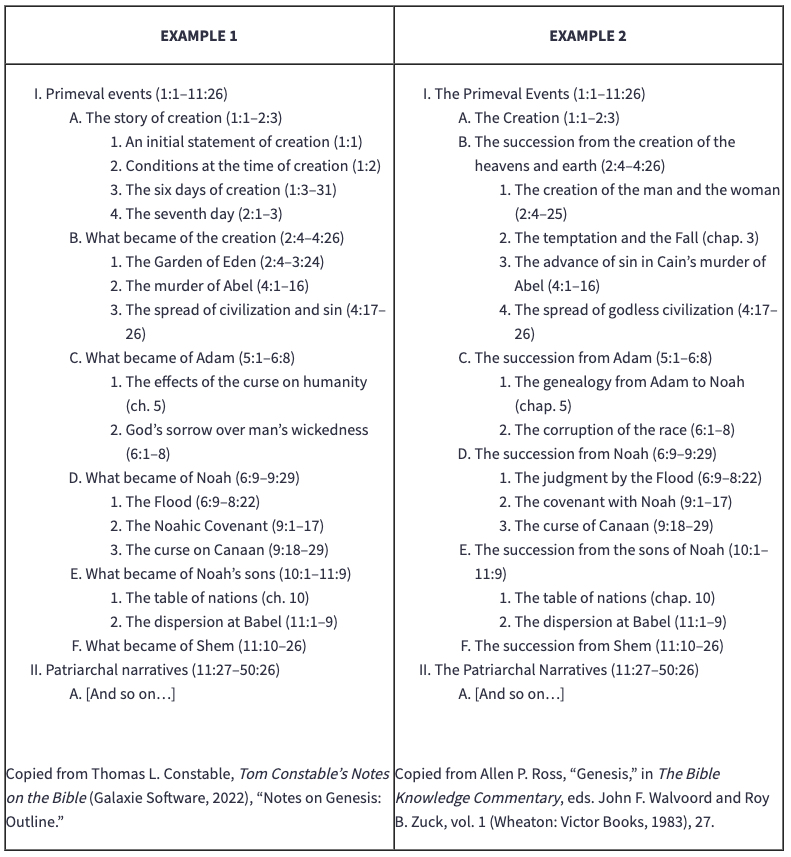
Please note that there is not necessarily one right way to structure this outline. Yours might look a bit different from someone else’s. In reviewing your work, our graders will only check to ensure that you hit on the key sections and themes of Genesis.
Part 2: Significance to Your Life and Ministry
After completing the outline portion of this assignment, you will need to write a brief paper reflecting on the significance of Genesis to your life and ministry. This paper will have three main sections, as listed below:
PLEASE NOTE: For this assignment, instead of submitting a written report, you may choose to submit an oral report recorded on audio if you wish. Nevertheless, if you do this, all the same elements which are required for the written report must be covered thoroughly in your oral report. Also, at present our online platform can only receive submissions less than 100 MB in size, so please ensure that any audio file is smaller than this. You can upload up to five files at once per assignment if needed, for a maximum of 500 MB per assignment. However, you must upload all the files for the assignment at the same time, otherwise your new submission will overwrite any previous submissions for that assignment.
Instructions
To successfully complete the Old Testament Track with the DTS Global Institute, you must read all three items listed below. After reading everything listed, please submit your reading report. To do so, scroll to the bottom of this lesson, write up answers to the questions listed there, and submit your answers in a single file. This will allow you to reflect briefly on your reading and will affirm that you have in fact read all of the following:
We recommend reading the following resources as well, though they are not required for completing the program:
NOTE: All the resources listed above are included in the free Logos package provided to you.
Once you have finished the assigned reading for your Track, please submit brief answers for the reflection questions listed below. Each “takeaway” can be just a sentence or two long. This will serve as confirmation that you have completed the reading assignment.
1) Please name ONE brief takeaway from each of the 39 books of the Old Testament which you read. Make sure each insight listed is unique to the book in question and fits the book’s overall message/themes.
2) Please name 3-4 brief takeaways which you found to be impactful in reading Exploring Christian Scripture by Kreider, Svigel, and Yarbrough.
3) Please name 3-4 brief takeaways which you found to be impactful in reading Jonah: Beyond the Tale of a Whale by Mark Yarbrough.
4) If you have any other thoughts about the readings which you’d like to share, please do so here. (Optional)
PLEASE NOTE: For this assignment, instead of submitting a written report, you may choose to submit an oral report recorded on audio if you wish. Nevertheless, if you do this, all the same elements which are required for the written report must be covered thoroughly in your oral report. Also, at present our online platform can only receive submissions less than 100 MB in size, so please ensure that any audio file is smaller than this. You can upload up to five files at once per assignment if needed, for a maximum of 500 MB per assignment. However, you must upload all the files for the assignment at the same time, otherwise your new submission will overwrite any previous submissions for that assignment.
For this assignment, you will be required to outline the entire Old Testament, from Genesis to Malachi. However, keep in mind that you only need to go three “levels” deep on the outline. In other words, just identify the main groupings of books with I, II, III, etc.; the names of the books with A, B, C, etc.; and the main sections of each book with 1, 2, 3, etc. There is no need to go into further detail.
The purpose of this assignment is to ensure that you have a grasp of the overall structure and progression of the Old Testament, giving a “big picture” view of the story throughout. You will have the chance to go into a bit more detail on a particular book of the Old Testament in your other writing assignment and in your teaching assignment.
Also, next to each point/subpoint on your outline, please be sure to identify which section of Scripture the point/subpoint is referring to. For example:
Please note that there is not necessarily one right way to structure this outline. Yours might look a bit different from someone else’s. In reviewing your work, our graders will only check to ensure you hit on the main themes and major sections of the Old Testament.
To help you get started, a common way of dividing the books of the Old Testament is as follows (5 – 12 – 5 – 5 – 12):
PLEASE NOTE: For this assignment, instead of submitting a written report, you may choose to submit an oral report recorded on audio if you wish. Nevertheless, if you do this, all the same elements which are required for the written report must be covered thoroughly in your oral report. Also, at present our online platform can only receive submissions less than 100 MB in size, so please ensure that any audio file is smaller than this. You can upload up to five files at once per assignment if needed, for a maximum of 500 MB per assignment. However, you must upload all the files for the assignment at the same time, otherwise your new submission will overwrite any previous submissions for that assignment.
For this assignment, you will be required to teach through the Old Testament book of Jonah. Please feel free to do this in whatever way best fits your ministry context! To help you get started, we have provided you with a sample curriculum for three different settings—preaching, small group leadership, and one-on-one discipleship. We suggest you adapt these resources as needed for your ministerial and cultural contexts. You will find them all posted as downloadable files below.
The one stipulation for how to go about teaching this book is that you split it into four (4) lessons, one for each chapter of Jonah. This should be true whether these are four sermons, four small-group sessions, four one-on-one sessions, or something else. This will give you multiple instances of practice and will help you have more to reflect on for your final self-evaluation.
Once you have finished all four teachings on Jonah, please return to this course and complete the “Self-Evaluation Report” in the next lesson below. This will serve as confirmation that you have completed the teaching assignment.
A FEW TIPS:
Please download and review the sample curriculum below. Although you may end up teaching in a different setting, we have provided curriculum for preaching, for small-group leadership, and for one-on-one discipleship sessions. Feel free to use any of these as they are, alter them as needed, or develop your own lesson plans. Regardless of which option you choose, however, we encourage you to adapt your four teachings to best serve the needs of your current cultural and ministerial context.
Once you have finished teaching all four lessons on Jonah, please submit your answers to the self-evaluation questions listed below (in a single file). This will serve as confirmation that you have completed the teaching assignment.
1) Looking back on this experience, what were the strong points of my teaching? Weak points?
2) What would I change if I taught this again?
3) What did I find most interesting/exciting about this teaching experience? Most frustrating/challenging?
4) What were my goals in teaching through this book of the Bible, and why were these chosen?
5) How well did I meet these goals? Did I encounter any particular obstacles?
6) Throughout this experience, did I witness any growth in those I was teaching? If so, what specifically?
7) Throughout this experience, did I witness any growth in myself? If so, what specifically?
8) Any additional thoughts? (Optional)
PLEASE NOTE: For this assignment, instead of submitting a written report, you may choose to submit an oral report recorded on audio if you wish. Nevertheless, if you do this, all the same elements which are required for the written report must be covered thoroughly in your oral report. Also, at present our online platform can only receive submissions less than 100 MB in size, so please ensure that any audio file is smaller than this. You can upload up to five files at once per assignment if needed, for a maximum of 500 MB per assignment. However, you must upload all the files for the assignment at the same time, otherwise your new submission will overwrite any previous submissions for that assignment.